 Web HostingMost affordable shared hosting from TZS 9,100 per year
 Dedicated ServersExperience unmatched power and control with a physical server in Tanzania.
 WordPress HostingHigh-Speed, Tanzania-Optimized WordPress Hosting
 Windows HostingOptimized for Windows-based applications and websites
 cPanel HostingUser-friendly hosting powered by cPanel
 Email HostingProfessional Tanzanian email hosting for your .co.tz domain (Secure, reliable, and Swahili-supported)
 Reseller HostingLaunch your own hosting business with minimal technical requirements
 Affiliate ProgramEarn referral commissions by promoting our services
 DomainsFind and register available domain names in seconds
 Domain TransferMove your domain to us with zero downtime and full control
 .co.tzSecure the trusted .co.tz domain made for Tanzanian businesses.
 .tz DomainClaim the official .tz domain for national trust and recognition.
 .com DomainSecure the trusted .com domain for Tanzanian businesses.
 Supported Tlds (glTLDs and ccTLDs)Browse and register domain extensions from around the world
 Whois Lookup | Find Out Who Owns a DomainLook up domain ownership, expiry dates, and registrar information
 VPS
VPS VPS Hosting TanzaniaDedicated resources. Tanzanian performance. Full server control.
 Managed VPS TanzaniaNot a tech expert? Choose a managed Tanzania VPS.
 Website BuilderEasily build beautiful websites with drag-and-drop simplicity.
 Online ShopLaunch a professional e-commerce store without writing code.
 BlogFind latest business, marketing, and tutorials
Picture this scenario. You build a great website for a client. You hand it over, and the client goes straight to a third-party hosting company to pay for server space. That money does not come back to you.
Every month, that hosting provider collects anywhere from TZS 15,000 to TZS 50,000 per client. Multiply that across 20 or 50 clients, and you are watching a significant monthly income stream go to someone else’s business.
To make things worse, when a client’s website goes down, they still call you. You have to solve the problem with zero control over the server. That is a frustrating position to be in.
White-label hosting changes that completely. It lets you sell hosting under your own brand, set your own prices, and keep the recurring revenue, all without buying a single server.
This guide covers what white-label hosting is, how it works step by step, and what it looks like specifically in Tanzania’s growing digital market.
What is White Label Hosting?

White-label hosting is a business model where you sell web hosting services under your own brand name.
The actual servers, infrastructure, and technical maintenance belong to a provider working behind the scenes.
Your clients never see that provider’s name. They see your logo, your company name, and your contact details on every invoice, every email, and every control panel login page.
The Three Parties in Every White Label Arrangement
Understanding who plays each role makes the model much easier to grasp.
Every white-label hosting arrangement involves three distinct parties.
The infrastructure provider: This company owns the physical servers, data centers, and network connections. They handle uptime, hardware maintenance, and security updates.
You, the reseller: You purchase server resources in bulk at wholesale rates. You brand everything, set your prices, and manage your client relationships.
Your end clients: These are the business owners, NGOs, or individuals who buy hosting from you. They interact only with your branded platform.
What ‘White Label’ Means at the Technical Level
The branding goes deeper than just a logo. When a hosting plan is fully white-labeled, several elements carry your identity instead of the provider’s.
From the client’s perspective, they are doing business entirely with you. The upstream provider is invisible at every touchpoint.
- Private nameservers show your domain (for example, ns1.yourbrand.co.tz and ns2.yourbrand.co.tz) rather than the provider’s servers.
- The cPanel login page displays your logo and company colors, not the provider’s interface.
- Invoices and billing emails come from your company name and email address.
- Support ticket systems show your brand in every communication thread.
How White Label Hosting Works: The Four Steps
The mechanics of white-label hosting follow a logical sequence. Each step builds on the previous one, and once the system is set up, most of it runs automatically.
Step 1: You Purchase Bulk Server Resources from a Provider
You sign up for a reseller hosting plan and pay a fixed monthly or annual fee.
In exchange, you get access to a set amount of disk space, bandwidth, and a number of cPanel accounts you can create for clients.
You also get access to WHM, the control panel that sits above cPanel. WHM lets you create individual hosting packages and allocate resources to each account.
Alongside WHM, most providers include WHMCS (Web Hosting Manager Complete Solution).
This software handles billing, invoice generation, automated account provisioning, and client communications on your behalf.
Step 2: You Brand Everything as Your Own
Before you onboard a single client, you set up your brand across every touchpoint. This process is usually straightforward and takes a few hours.
- Log into WHM and set your custom nameserver records (for example, ns1.yourdomain.co.tz).
- Upload your company logo to the cPanel theme so clients see your brand on login.
- Configure WHMCS with your company name, email address, and payment settings.
- Set up an invoice template with your brand colors and contact details.
After this setup, your clients interact with a platform that looks entirely like your own product.
Step 3: You Create Hosting Packages and Set Your Prices
Inside WHM, you create packages that define what each client gets: how much storage, how many email accounts, how many databases, and how much bandwidth.
You then decide what to charge. The pricing is entirely up to you. Your profit comes from the margin between what you pay the provider and what you charge your clients.
Here is a simple example. If you pay TZS 145,000 per month for a mid-tier reseller plan that supports 30 client accounts, and you charge each client TZS 15,000 per month, your gross revenue is TZS 450,000.
Your margin on the hosting alone is TZS 405,000 before other costs.
Step 4: Clients Sign Up, and Everything Runs Automatically
Once your WHMCS store is live, clients visit your website, pick a hosting plan, and pay through your chosen payment gateway.
In Tanzania, that often means M-Pesa, Tigo Pesa, Airtel Money, or a local bank transfer.
WHMCS receives the payment confirmation and automatically creates the client’s cPanel account within minutes.
The client gets a branded welcome email with their login details. No manual work is needed on your end.
From that point on, clients log in to your branded cPanel to manage their website files, email accounts, and databases.
They submit support tickets through your branded helpdesk.
They renew their hosting through your WHMCS client area. Their entire experience lives inside your brand.
Why White Label Hosting Makes Sense in Tanzania Right Now

The business case for white-label hosting in Tanzania is tied directly to what is happening in the country’s digital economy. The numbers tell a clear story.
1) Tanzania’s Internet Growth Is Accelerating
As of March 2026, Tanzania had 58.9 million internet users. That figure represents a 19.5 percent increase from 49.3 million just twelve months earlier. At the same time, registered mobile phone lines grew to 111.9 million.
The government’s Tanzania Digital Economy Strategic Framework (2024 to 2034) is actively pushing e-commerce adoption, digital financial services, and e-government platforms.
Each of these initiatives creates demand for reliable web hosting.
2) Over 5 Million SMEs Still Need Professional Web Hosting
Small and medium-sized enterprises make up approximately 95 percent of all businesses in Tanzania and contribute around 35 percent of GDP. The country has over 5 million registered SMEs.
Studies show that 84 percent of Tanzanian SMEs have adopted digital payment systems.
Yet a large share of those same businesses still lack professional websites or rely on free platforms that cannot handle business growth.
That gap is your market. Every SME that decides to build a website becomes a potential hosting client.
Web designers and developers who can offer hosting alongside their services position themselves as the logical first choice.
3) Recurring Revenue Changes How an Agency Grows
Project-based income is unpredictable. In one month, you have three new website builds.
The next month you have none. Hosting revenue is different because it arrives every month without requiring new client acquisition.
A web designer who hosts 30 clients at TZS 15,000 per month earns TZS 450,000 per month in predictable income.
That baseline makes it far easier to plan expenses, hire staff, or invest in marketing.
4) Mobile Money Integration Removes the Biggest Payment Barrier
Collecting payments from Tanzanian clients is straightforward when your billing system supports local payment methods.
WHMCS has modules available for M-Pesa, Tigo Pesa, and Airtel Money.
Here is how the payment flow works in practice. A client receives an invoice from your WHMCS system. They pay via M-Pesa using the USSD code or the app on their phone.
The payment confirmation triggers WHMCS automatically. The client’s hosting account activates or renews without any manual intervention from you.
This level of automation matters in a market where mobile money penetration is far higher than traditional bank card usage.
It removes friction from the renewal process and reduces client churn from failed payments.
How to Launch Your White Label Hosting Business in Tanzania
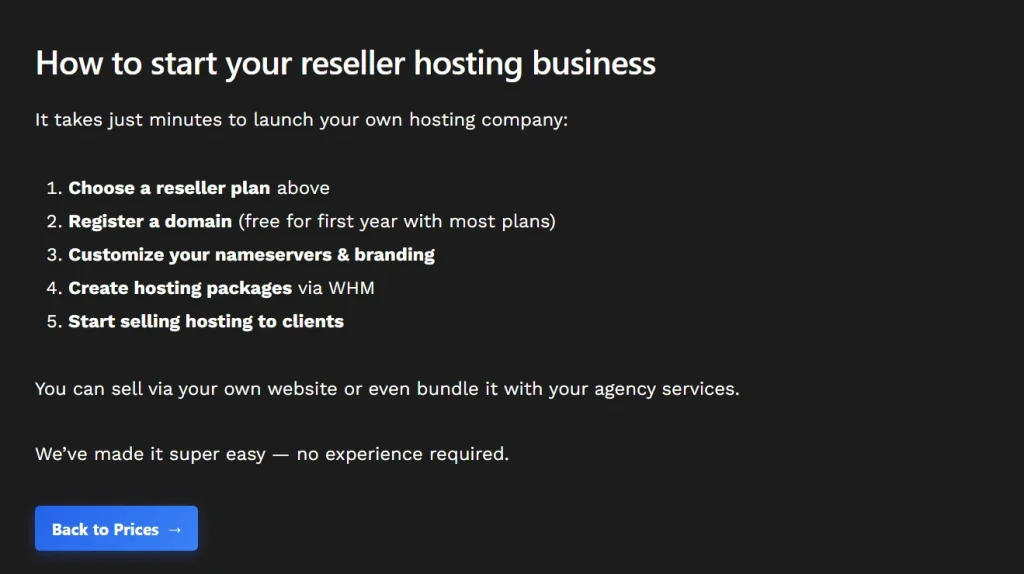
The setup process is manageable when you break it into three focused weeks.
Here is a week-by-week plan that gets you from zero to your first paying client.
Week 1: Build Your Foundation
A) Register your business. If you plan to operate formally, register with BRELA (Business Registrations and Licensing Agency) and get a TIN from TRA. A registered business builds credibility with corporate clients and NGOs.
B) Register a .co.tz domain for your brand. A local domain extension signals that your business is based in Tanzania, which matters to local clients. Set up a professional email on that domain (for example, [email protected]).
C) Choose and purchase your reseller hosting plan. Start with a mid-tier plan that gives you room to grow without overpaying for resources you do not need yet.
D) Configure your private nameservers in WHM and apply your brand logo and colors to the cPanel theme. These two steps are the visible markers of a white-labeled product.
E) Set up WHMCS. Connect it to your hosting provider’s API so account provisioning happens automatically. This setup takes a few hours but saves hundreds of hours later.
Week 2: Build Your Systems and Pricing Structure
F) Create two or three hosting packages in WHM. A simple structure works well: Starter (enough for a basic business website), Business (for sites with moderate traffic), and Premium (for e-commerce or high-traffic clients).
G) Set your retail prices. Research what competitors charge in your local market. Position your pricing at a level that covers your costs, leaves a healthy margin, and stays competitive. Avoid dropping prices below what the market can sustain.
H) Connect a payment gateway to WHMCS. Configure M-Pesa and at least one other local payment method. Test the entire checkout and provisioning flow before going live.
I) Write a terms of service document and an acceptable use policy. These protect your business legally and set clear expectations with clients.
J) Build a simple hosting page on your website. List your packages, prices, and features. Make the order process easy to find.
Week 3: Go Live and Acquire Your First Clients
K) Move your existing web design clients to your new hosting platform. Offer them one free month as an incentive. Most clients who are already happy with your work will accept the move without hesitation.
L) Announce your hosting services through WhatsApp business groups, LinkedIn posts, and local tech communities in Dar es Salaam, Arusha, and Mwanza.
M) Reach out to other web designers who do not currently offer hosting. Propose a referral arrangement where they send clients your way in exchange for a recurring commission.
N) Create a basic knowledge base with answers to the most common questions: how to set up email in cPanel, how to install WordPress and how to renew a hosting plan. This reduces the support load from day one.
Is White Label Hosting Worth It in Tanzania?
The answer depends on one thing: do you already serve clients whose websites need a home?
If you manage five or more client websites and currently hand those clients off to a third-party host, you are leaving predictable monthly income on the table.
White-label hosting lets you capture that income with a relatively small upfront investment of time and money.