 Web HostingMost affordable shared hosting from TZS 9,100 per year
 Dedicated ServersExperience unmatched power and control with a physical server in Tanzania.
 WordPress HostingHigh-Speed, Tanzania-Optimized WordPress Hosting
 Windows HostingOptimized for Windows-based applications and websites
 cPanel HostingUser-friendly hosting powered by cPanel
 Email HostingProfessional Tanzanian email hosting for your .co.tz domain (Secure, reliable, and Swahili-supported)
 Reseller HostingLaunch your own hosting business with minimal technical requirements
 Affiliate ProgramEarn referral commissions by promoting our services
 DomainsFind and register available domain names in seconds
 Domain TransferMove your domain to us with zero downtime and full control
 .co.tzSecure the trusted .co.tz domain made for Tanzanian businesses.
 .tz DomainClaim the official .tz domain for national trust and recognition.
 .com DomainSecure the trusted .com domain for Tanzanian businesses.
 Supported Tlds (glTLDs and ccTLDs)Browse and register domain extensions from around the world
 Whois Lookup | Find Out Who Owns a DomainLook up domain ownership, expiry dates, and registrar information
 VPS
VPS VPS Hosting TanzaniaDedicated resources. Tanzanian performance. Full server control.
 Managed VPS TanzaniaNot a tech expert? Choose a managed Tanzania VPS.
 Website BuilderEasily build beautiful websites with drag-and-drop simplicity.
 Online ShopLaunch a professional e-commerce store without writing code.
 BlogFind latest business, marketing, and tutorials
Having a Google Business Profile is not the same as ranking on Google Maps. Most Tanzanian businesses have one.
Very few have optimized it. That gap is exactly where rankings are won or lost.
If your business is missing from the top 3 spots on Google Maps, you are losing real customers every single day.
This guide covers exactly what Google checks before ranking a Tanzanian business in the Map Pack.
From verification to reviews, citations, and AI visibility, every section is written for the Tanzanian context.
Why Google Maps Matters More Than Ever for Tanzanian Businesses
Tanzania had 58.6 million internet subscriptions as of December 2025. That number grows at 5.6% every quarter, according to TCRA data.
Mobile broadband accounts for over 99% of all connections in the country. This means most people searching for a nearby business are doing so from a phone while out and about.
Globally, 46% of all Google searches carry local intent. On top of that, 76% of people who run a local search on a smartphone visit a related business within 24 hours.
For Tanzanian businesses, that connection between online search and foot traffic is real and measurable.
With 4G now covering 94.2% of the population and 5G reaching 28.9%, connection quality keeps improving.
More customers are searching before they walk through any door.
The businesses appearing at the top of Google Maps are the ones that customers walk into.
What the Google Map Pack Is and Why the Top 3 Spots Win Everything
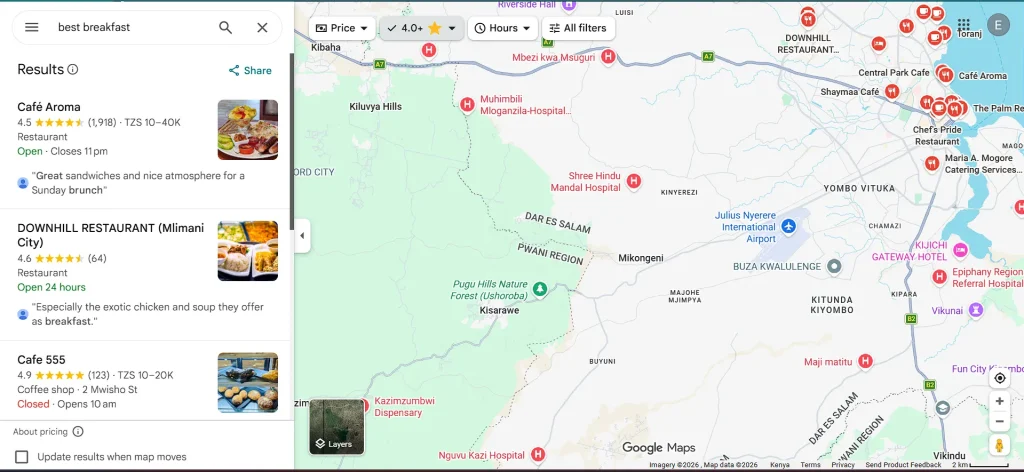
The Map Pack is the three-business cluster that appears above organic results. It shows up whenever someone types a local query into Google Maps.
Searching “pharmacy Dar es Salaam,” for example, brings up a map with three listed businesses before anything else.
Businesses outside those top 3 spots are effectively invisible to most mobile users. On a small phone screen, the Map Pack fills the entire first view before any organic results appear.
Getting into that top 3 is not just helpful. It is the difference between getting found and being ignored.
How Google Decides Who Ranks on Google Maps in Tanzania
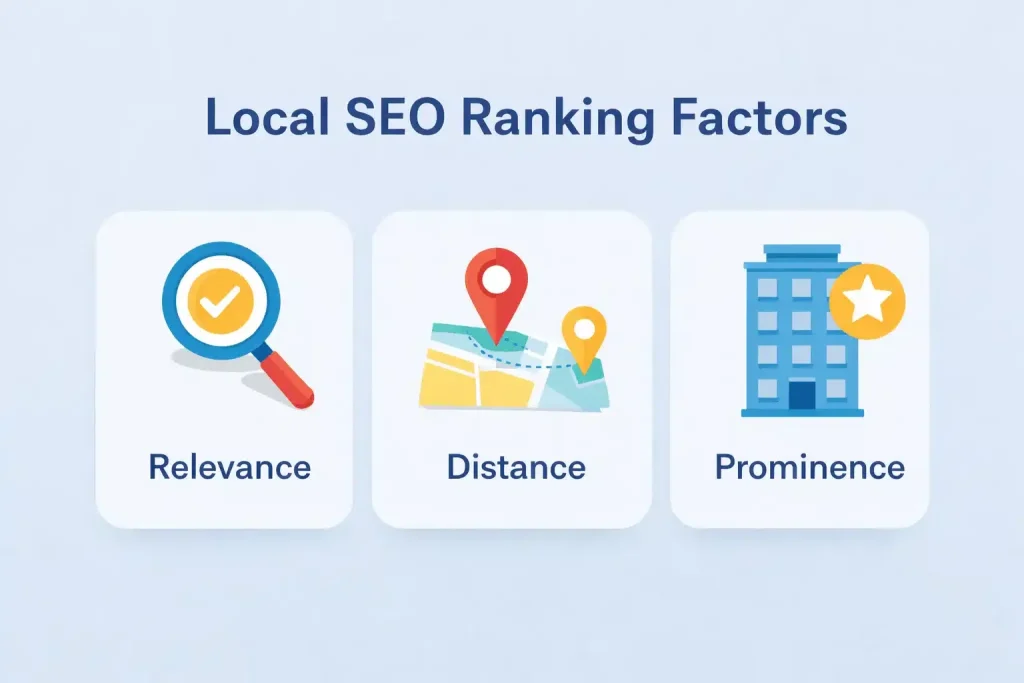
Google ranks businesses using three main factors: relevance, distance, and prominence.
Relevance measures how well your listing matches what someone searched for.
Distance measures how close your business is to the person searching.
Prominence reflects how trusted and well-known your business appears across the web.
Proximity is the one factor you cannot change with SEO. That said, you can directly influence both relevance and prominence.
Those two factors often decide the winner between businesses at a similar distance.
One common misconception is worth clearing up here. Having a physical address in Dar es Salaam does not automatically make a business visible citywide. Google ties your ranking radius to your verified location.
The Newer Signals That Matter in 2026
Behavioral signals now sit alongside the classic three factors. Clicks from search results, calls placed from the profile, requests for directions, and time spent on the listing all feed into Google’s ranking logic.
Google’s Gemini AI integration has shifted how sub-factors within relevance and prominence are weighted.
Profiles that show genuine real-world activity now rank higher than those that look static.
Tanzanian businesses in 2026 also need to think about AI visibility. Platforms like ChatGPT use Bing data to surface local business recommendations, so a Bing Places listing is no longer optional.
Step 1: Set Up and Verify Your Google Business Profile in Tanzania
Your primary category is the single highest-leverage field in the entire profile.
Select it carefully. “Restaurant” is broad. “Swahili Restaurant” or “Seafood Restaurant” tells Google exactly who you serve in Dar es Salaam.
After choosing the right category, focus on NAP consistency.
NAP stands for Name, Address, and Phone number. Your business name, address, email, and phone number must be identical across every platform.
This includes your website, Facebook page, Yellow Pages Tanzania, and the GBP itself. Any mismatch sends conflicting signals to Google.
Here is a checklist of the 10 profile fields that need to be fully completed:
- Business name
- Primary category
- Additional categories
- Business address or service area
- Phone number
- Website URL
- Business hours
- Business description
- Photos (at least 5)
- Products or services section
Step 2: Optimize Your GBP to Win on Relevance
The description field allows up to 750 characters. Only the first 250 are visible before a user clicks “more.”
Front-load your primary keyword and the city or district name within those first 250 characters.
Avoid writing a description that reads like a corporate mission statement.
Write it as a direct answer to this question: what do you do, where, and for whom?
Photos, Posts, and Attributes as Ranking Fuel
Geotagged images uploaded on a regular schedule send consistent activity signals to Google.
Google treats an active profile as more relevant than a dormant one. Aim for at least two new photos per week to maintain that activity signal.
GBP posts work similarly to social media posts, but they expire after 7 days.
Each post is indexed, so a business that posts weekly always has fresh content signaling relevance.
A competitor that last posted six months ago looks abandoned by comparison.
Step 3: Build Reviews That Google Trusts and Ranks
In competitive Western markets, businesses often need 50 or more reviews to rank.
Tanzania is different. In most cities outside central Dar es Salaam, 15 to 30 high-quality, recent reviews can place a business in the top 3.
Review velocity matters more than total count. Getting 5 new reviews in a month outweighs having 100 old ones where the last arrived six months ago.
Google weighs review recency heavily. So keep a steady flow of fresh reviews coming in.
Responding to Reviews the Right Way
Google indexes every review response. Someone mentions “best nyama choma in Kinondoni” in their review. Responding with the word “Kinondoni” in your reply reinforces your geographic relevance signal. This is a small but effective habit to build.
Negative reviews hurt more when ignored than when answered. A calm, solution-focused reply to a 1-star review signals to Google and future customers that the business is actively managed. That matters more than many people realize.
One rule to follow without exception: never offer discounts in exchange for reviews.
Google’s detection for fake-review patterns has sharpened considerably in 2026.
Violations can result in profile suspension, which wipes out all the ranking progress you have built.
Step 4: Build NAP Citations Across Tanzanian Directories
A citation is any online mention of your business name, address, and phone number.
Google cross-references these across dozens of platforms to confirm your business is real and operates where it claims.
NAP consistency across 50 or more directories is what Google needs to trust your location data fully. Inconsistencies directly suppress Map Pack rankings.
In the Tanzanian context, priority citation sources include Yellow Pages Tanzania, Jiji.co.tz, TCRA-registered business directories, and your own website contact page.
Getting listed on these platforms is not difficult. The challenge is keeping the information consistent everywhere.
Step 5: Use Your Website to Strengthen Your Map Pack Position
A GBP without a website can rank, but businesses with a mobile-optimized website consistently outrank those without one.
Google treats a linked website as a trust signal. So having a site matters.
The website’s contact page must carry the same NAP information as the GBP.
A mismatch between your website phone number and your GBP phone number is one of the most common and most damaging consistency errors. Fix it before anything else.
Beyond NAP, add LocalBusiness schema markup to your homepage and contact page.
This structured data tells Google’s crawlers your business type, address, hours, and geographic service area in machine-readable format.
It takes less than an hour to set up and pays off in stronger local ranking signals.
Common Reasons Your Business Is Not Showing on Google Maps in Tanzania
Unverified profile: This is the most common reason. Many Tanzanian businesses started a GBP listing, got stuck at the verification step, and left it unfinished. An unverified profile never ranks.
Suspended profile: GBP suspensions happen when the business name includes promotional keywords, the address is a P.O. box, or the category does not match what the business actually does.
NAP inconsistencies: The phone number on the GBP differs from the one on your domain name or Facebook page. Google sees this as conflicting signals and reduces trust in your listing.
No recent activity: A profile with zero posts, no new photos, and reviews from two years ago looks inactive. Google deprioritizes stale profiles in competitive Map Pack positions.
Wrong primary category: Choosing “Business Center” instead of “Coworking Space,” or “Shop” instead of “Electronics Store,” puts your business in the wrong relevance bucket for the searches you want to rank for.
Frequently Asked Questions
How long does it take to rank on Google Maps in Tanzania?
With a verified profile, complete information, and active review collection, many businesses see movement in the Map Pack within 30 to 60 days. Competitive categories in central Dar es Salaam may take a bit longer.
Can I rank my business on Google Maps with just a mobile phone?
Yes. You can create, verify via video, and manage your entire GBP from a smartphone. The Google Business Profile app makes the whole process manageable from anywhere.
What happens if a competitor reports my GBP listing?
Google reviews reported listings manually. If your profile is accurate and your business is legitimate, a report will not result in suspension. Keep your information up to date and accurate at all times as a safeguard.
How do I track whether my Google Maps ranking is improving?
Use GBP Insights to monitor search impressions, direction requests, and website clicks from your profile.
Can a business in Tanzania rank on Google Maps without a physical address?
Yes. Using Google’s Service Area Business (SAB) configuration, you can hide your home address and set your coverage area by district or region.
However, a physical, verifiable address still provides a stronger proximity signal than a service area setting alone. If you have an office or shop, use that address.
Do I need a website to rank on Google Maps in Tanzania?
No, a website is not required to appear in Google Maps. That said, businesses with a linked, mobile-optimized website consistently outrank those without one.
The website adds trust signals and NAP consistency that reinforce the GBP. If you do not have a website yet, getting one set up should be on your short list.
Put Your Business at the Top on Google Maps
Every week, your profile sits unoptimized, and a competitor collects the customers who were searching for you.
The steps in this guide work. They take time, consistency, and attention to detail across every platform.
For businesses that want results without managing the process themselves, Truehost LocalForce Maps handles the full setup and ongoing optimization.