 Web HostingMost affordable shared hosting from TZS 9,100 per year
 Dedicated ServersExperience unmatched power and control with a physical server in Tanzania.
 WordPress HostingHigh-Speed, Tanzania-Optimized WordPress Hosting
 Windows HostingOptimized for Windows-based applications and websites
 cPanel HostingUser-friendly hosting powered by cPanel
 Email HostingProfessional Tanzanian email hosting for your .co.tz domain (Secure, reliable, and Swahili-supported)
 Reseller HostingLaunch your own hosting business with minimal technical requirements
 Affiliate ProgramEarn referral commissions by promoting our services
 DomainsFind and register available domain names in seconds
 Domain TransferMove your domain to us with zero downtime and full control
 .co.tzSecure the trusted .co.tz domain made for Tanzanian businesses.
 .tz DomainClaim the official .tz domain for national trust and recognition.
 .com DomainSecure the trusted .com domain for Tanzanian businesses.
 Supported Tlds (glTLDs and ccTLDs)Browse and register domain extensions from around the world
 Whois Lookup | Find Out Who Owns a DomainLook up domain ownership, expiry dates, and registrar information
 VPS
VPS VPS Hosting TanzaniaDedicated resources. Tanzanian performance. Full server control.
 Managed VPS TanzaniaNot a tech expert? Choose a managed Tanzania VPS.
 Website BuilderEasily build beautiful websites with drag-and-drop simplicity.
 Online ShopLaunch a professional e-commerce store without writing code.
 BlogFind latest business, marketing, and tutorials
You need a backend for your web or mobile app. Building one from scratch takes months.
Paying a backend developer costs more than most Tanzanian startups can afford early on.
So you start searching for a shortcut. You find Firebase, Appwrite, and Supabase.
The names blur together fast. Each one promises to handle the hard parts so you can focus on the product.
Here is the truth about Supabase, stated plainly. It is not traditional web hosting.
Supabase is an open-source Backend-as-a-Service (BaaS) platform. It is built on PostgreSQL, a battle-tested relational database trusted by engineers across major enterprises.
You get a full backend without writing backend code from scratch.
This guide covers all of it. By the end, you will know exactly what Supabase is, the two ways to run it from Tanzania, which option fits your legal situation, and the steps to get your first project live.
How Supabase Differs From a Traditional Web Host
Many developers confuse Supabase with shared or VPS hosting. They serve completely different purposes.
A traditional host with cPanel gives you server space for your files. Supabase gives you a fully managed backend layer for your data and logic.
Your frontend, whether it is React, Vue, Flutter, or plain HTML, still needs its own host.
Pair Supabase with Vercel, Netlify, or a local Tanzanian VPS for the full stack. Supabase handles only the backend side of that equation.
Each Supabase project is one self-contained unit. It gets its own PostgreSQL database, authentication service, file storage, and API gateway.
All four services connect automatically; no manual configuration is needed between them.
Core Supabase Features That Matter for Tanzania Developers
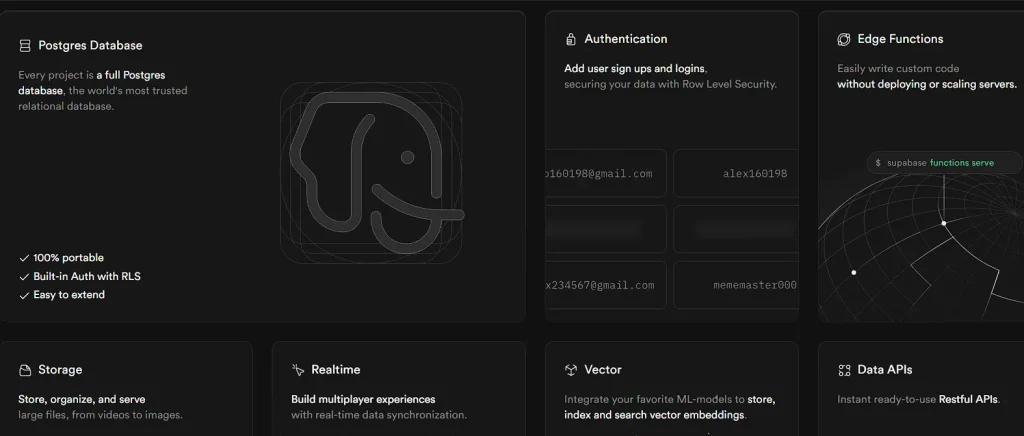
PostgreSQL Database. Supabase gives you full SQL access, not a locked-down abstraction layer. Run complex joins, foreign key relationships, and ACID transactions.
This matters greatly for fintech, e-commerce, and inventory apps common in Tanzania.
Authentication. The built-in auth system handles email/password, magic links, phone OTP, and social login via Google or GitHub.
You skip writing the entire authentication layer from scratch. That single feature saves weeks of development time for most projects.
Edge Functions. These are TypeScript serverless functions. They execute in the region nearest to the requesting user, not necessarily where your database lives.
Even if your database is in Frankfurt, an Edge Function can run in a node geographically closer to Dar es Salaam.
Realtime Subscriptions. Supabase uses WebSockets to push live database changes to connected clients.
Build live dashboards, order tracking, or collaborative tools without setting up a separate WebSocket server. This works out of the box.
File Storage. Store images, PDFs, and videos with built-in access controls.
Row-level security policies extend to files, too. Most small Tanzanian projects never need a separate cloud storage bucket.
Two Ways to Run Supabase in Tanzania
There are exactly two options: Supabase Cloud and self-hosted Supabase. Supabase Cloud is a fully managed service; Supabase handles all the infrastructure.
Self-Hosted Supabase means you deploy the open-source stack on a server you own and operate.
Both options run the same underlying open-source code. The features are identical on either path.
The difference is who manages the servers, applies security patches, and responds when something breaks at 3 AM.
Your choice depends on four things: your latency requirements, your data sovereignty obligations, your team’s technical depth, and your monthly budget.
Self-Hosting Supabase on a Tanzanian VPS
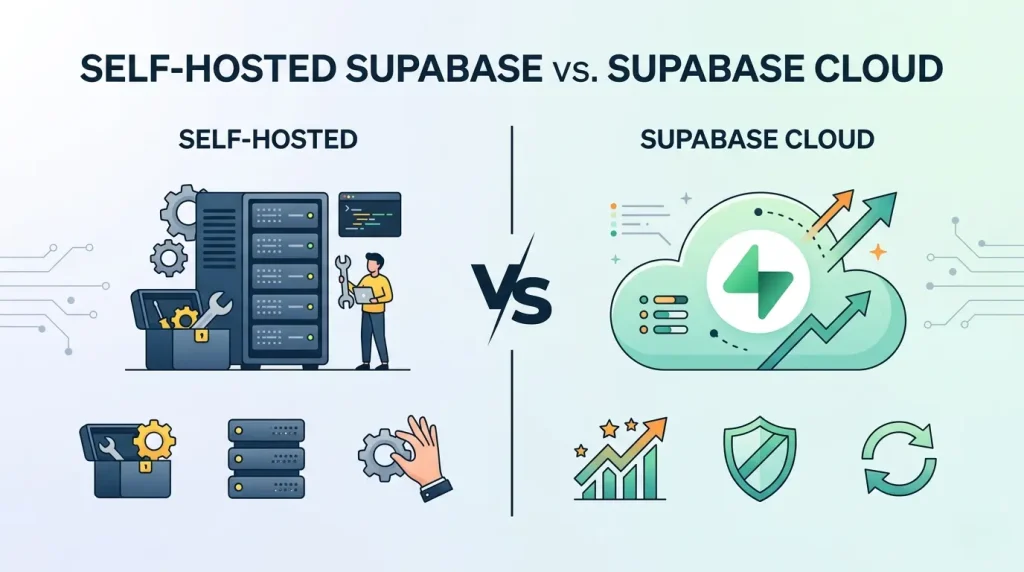
Self-hosting puts the entire Supabase stack on a server you control. Your data stays in Tanzania, or whatever country your server physically sits in. This approach eliminates the data residency problem entirely.
Supabase runs as a Docker Compose stack of approximately ten containers.
These include PostgreSQL, GoTrue (auth service), PostgREST (auto-generated REST API), a Realtime server, a Storage API, and the Kong API gateway. Each container handles one specific function.
Self-Hosting Trade-Offs: What You Take On
Self-hosting is not a set-and-forget solution. Every operational task that Supabase Cloud handles internally is now on you. Here is precisely what that means in practice.
Backups are your responsibility. Point-in-Time Recovery is not built into self-hosted Supabase.
You must configure pg_dump or pgBackRest yourself. Without this in place, a single server crash means total data loss.
Security is your responsibility. You patch the operating system, update Docker images, renew SSL certificates, and manage the firewall rules.
One misconfigured PostgREST setting can expose your entire PostgreSQL database to the public internet.
Uptime is your responsibility. No SLA exists. No, managed failover does not activate on its own.
If your VPS reboots at 2 AM, your app stays down until you manually intervene. Budget both time and money for a proper monitoring and alerting setup.
Supabase vs Firebase vs Appwrite: Which One Fits Tanzania?
Three platforms dominate BaaS for African developers: Supabase, Firebase, and Appwrite.
They are not interchangeable. Each one fits a different set of requirements.
| Feature | Supabase | Firebase | Appwrite |
| Database Type | PostgreSQL (SQL) | Firestore (NoSQL) | Document DB (NoSQL) |
| Open Source | Yes | No | Yes |
| Self-Hostable | Yes | No | Yes |
| Local Data Residency | Yes (via self-hosting) | Never possible | Yes (via self-hosting) |
| Free Tier | Generous | Generous | Yes |
| Vendor Lock-in Risk | Low | High | Very Low |
| Best For | Relational data, SQL, SaaS | Mobile-first, real-time | Privacy-first, full control |
Firebase is a strong choice for mobile-first prototypes that need offline sync and push notifications.
Its SDKs are mature, and the NoSQL model is forgiving for beginners.
The critical drawback: Firebase cannot be self-hosted. Data residency compliance is permanently off the table.
Appwrite is the easiest to self-host. It deploys with a single Docker command, far simpler than Supabase’s ten-container stack.
If full data ownership with minimal DevOps complexity is your top priority, Appwrite wins on that front.
Supabase wins when you need a real relational database with full SQL access.
Complex queries, foreign keys, ACID transactions, and the pgvector extension for AI features are all strengths of Supabase. Firebase cannot match any of them.
Supabase Pricing for Tanzania: Real Costs in USD and TZS
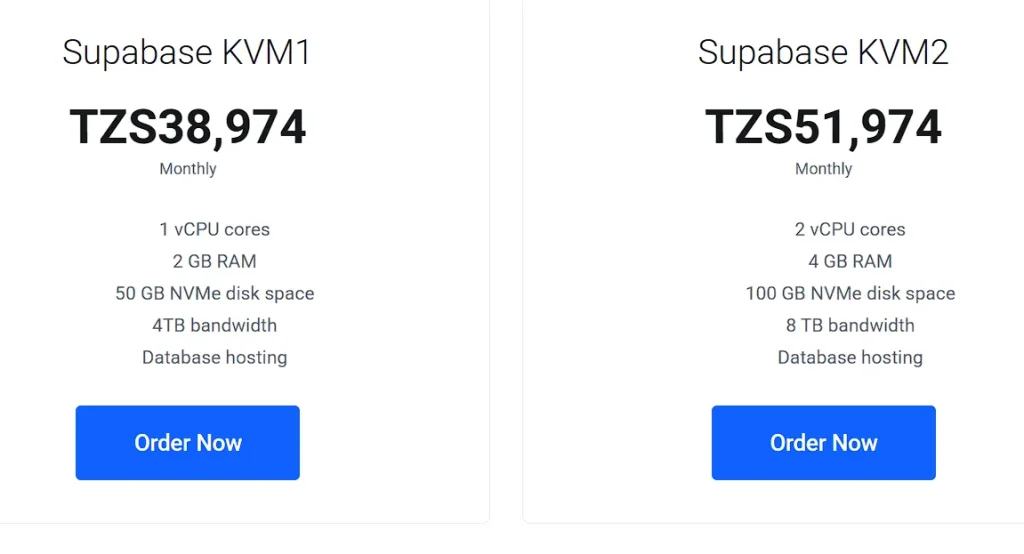
You can opt for the self-hosted Supabase, which is open source and free, but you will need to pay for a VPS hosting plan.
While you might be tempted by Supabase Cloud plans, it’s important to remember that the company has no servers in Africa. Ultimately, a self-hosted plan makes the most sense for a developer in Tanzania.
Tanzania’s PDPA 2022 and Supabase: What Developers Must Know
Tanzania’s Personal Data Protection Act (PDPA) of 2022 is not a suggestion. The Personal Data Protection Commission (PDPC) enforces it.
Any developer who collects or processes personal data of Tanzanian residents must comply.
Does your Supabase project store a user’s name, email, or phone number? Then you are almost certainly a data controller.
Data controllers must register with the PDPC before processing any personal data. Registration is valid for five years.
The Act sets clear processing rules. Data must be collected lawfully and for a specific, stated purpose.
It must not be retained longer than necessary. These principles apply regardless of where your database is physically hosted.
The Banking and Fintech Exception: When Local Hosting Is Mandatory
The Bank of Tanzania goes further than the PDPA for regulated financial services. Its ICT guidelines classify core customer databases as ‘Mission Critical Systems.’
Those systems must physically reside on servers inside Tanzania.
The compliant path for fintech is self-hosting. Deploy on a VPS at a data center physically located in Tanzania.
Implement encryption at rest and in transit. Register with the PDPC and follow Bank of Tanzania ICT security guidelines.
Frequently Asked Questions
Does Supabase have servers in Tanzania?
No. Supabase Cloud runs on AWS infrastructure only. No African region exists as of June 2026. The closest available region is Mumbai (ap-south-1), with roughly 100 ms of latency from Dar es Salaam.
Can I self-host Supabase in Tanzania?
Yes. Supabase is fully open-source and deploys via Docker Compose on any VPS. Local providers like Truhost in Tanzania are suitable hosting options for the stack.
Is Supabase free to use in Tanzania?
Yes. The Free tier gives you 500 MB of database storage, 1 GB of file storage, and 50,000 monthly active users at no cost. Free projects pause after one week of inactivity, so keep that in mind for production use.
Does Supabase comply with Tanzania’s PDPA 2022?
Supabase Cloud involves cross-border data transfer to AWS servers outside Tanzania. You must implement proper safeguards and register with the PDPC before going live.
Self-hosting on local Tanzanian infrastructure provides full data residency without the complications of data transfers.
The Right Supabase Path for Your Tanzania Project
Supabase gives a solo developer or a two-person team full PostgreSQL capability that they would otherwise need a backend engineer to build.
You get authentication, file storage, real-time subscriptions, and an auto-generated API. No backend team required.
Your next move is simple. Sign up for a Truehost Supabase self-hosted plan and start building your next big project.