 Web HostingMost affordable shared hosting from TZS 9,100 per year
 Dedicated ServersExperience unmatched power and control with a physical server in Tanzania.
 WordPress HostingHigh-Speed, Tanzania-Optimized WordPress Hosting
 Windows HostingOptimized for Windows-based applications and websites
 cPanel HostingUser-friendly hosting powered by cPanel
 Email HostingProfessional Tanzanian email hosting for your .co.tz domain (Secure, reliable, and Swahili-supported)
 Reseller HostingLaunch your own hosting business with minimal technical requirements
 Affiliate ProgramEarn referral commissions by promoting our services
 DomainsFind and register available domain names in seconds
 Domain TransferMove your domain to us with zero downtime and full control
 .co.tzSecure the trusted .co.tz domain made for Tanzanian businesses.
 .tz DomainClaim the official .tz domain for national trust and recognition.
 .com DomainSecure the trusted .com domain for Tanzanian businesses.
 Supported Tlds (glTLDs and ccTLDs)Browse and register domain extensions from around the world
 Whois Lookup | Find Out Who Owns a DomainLook up domain ownership, expiry dates, and registrar information
 VPS
VPS VPS Hosting TanzaniaDedicated resources. Tanzanian performance. Full server control.
 Managed VPS TanzaniaNot a tech expert? Choose a managed Tanzania VPS.
 Website BuilderEasily build beautiful websites with drag-and-drop simplicity.
 Online ShopLaunch a professional e-commerce store without writing code.
 BlogFind latest business, marketing, and tutorials
 Contact UsContact Truehost TZ | 24/7 Web Hosting Support
Your server can make or break your website. Traffic spikes. Pages slow. Customers bounce. Revenue drops.
The culprit isn’t always your design or content. Often, it’s how your server is managed.
Managed or unmanaged dedicated server hosting both give you full server power. But one saves you time, stress, and technical headaches. The other one, control is entirely to you, with more freedom but more responsibility.
In this guide, you’ll learn the differences between unmanaged and managed servers, the pros and cons of each, so you can choose the setup that keeps your website fast, secure, and ready to grow.
Managed vs Unmanaged Dedicated Server Hosting (Summary Overview)
The real difference between an unmanaged and a managed dedicated server isn’t the server itself. Rather, it’s who takes care of it.
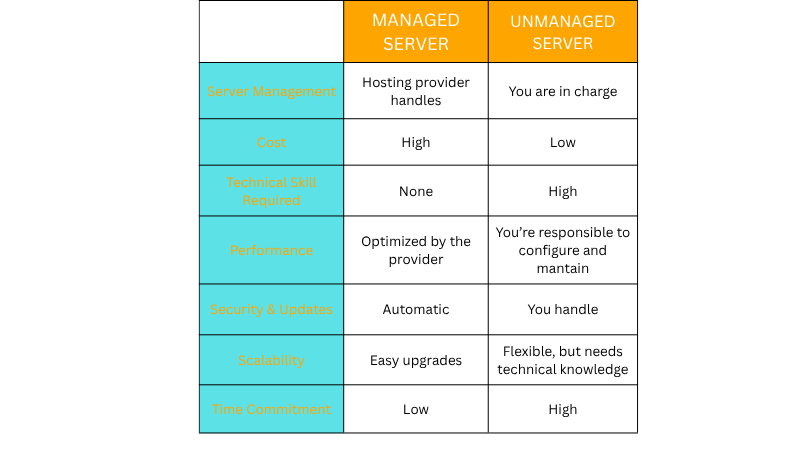
Here’s a quick overview of the difference between the two:
| Feature | Managed Dedicated Server | Unmanaged Dedicated Server |
| Server Management | The hosting provider handles setup, maintenance, updates, and troubleshooting | You are in charge of everything: setup, maintenance, patches, and monitoring |
| Cost | Higher monthly fees for expert support and convenience | Lower cost, but you trade money savings for your own time and effort |
| Technical Skill Required | None, as the server is managed by the web host | High. You need experience with server administration and problem-solving |
| Performance | Optimized by the provider for uptime, speed, and reliability | Full control, but you’re responsible for configuring and maintaining performance |
| Security & Updates | Automatic patches, monitoring, and proactive protection | You handle firewalls, backups, updates, and security policies |
| Scalability | Easy upgrades with provider support. RAM, CPU, and storage can grow as you need | Flexible, but scaling requires technical knowledge and manual adjustments |
| Time Commitment | Low. Focus on your business, not server issues | High. You spend hours managing, monitoring, and troubleshooting |
In summary, managed servers save time, reduce stress, and offer professional support, but at a higher cost. On the other hand, unmanaged servers give freedom and lower expenses but demand technical skill, effort, and careful maintenance.
Key Differences Between Managed and Unmanaged Dedicated Server Hosting
The difference between managed and unmanaged servers mainly from who manages the server.
But also, there are features that the two differ widely, and hence can affect everything from performance and security to cost and time spent on maintenance of your website.
So, let’s explore the key factors that will determine which option fits your website, team, and goals.
1) Server Management
Managed servers take the load off your shoulders.
The provider handles setup, configuration, monitoring, backups, and troubleshooting. So, your website runs smoothly without you worrying about crashes or conflicts.
On the other hand, unmanaged servers give you full control, but that comes with full responsibility.
You install the OS, configure software, manage updates, and fix issues yourself. That means you need to be an expert and careful, because missing a critical patch can make your site vulnerable.
2) Cost
Managed hosting comes at a premium. You’re paying for expert support, security, and peace of mind. So, higher monthly fees and occasional setup costs are expected.
That’s unlike unmanaged hosting, which is cheaper.
You pay only for the server hardware, but the savings come at the price of your time and effort. You handle maintenance, updates, and troubleshooting yourself.
Therefore, choosing managed hosting can reduce these indirect costs by saving staff hours and minimizing downtime.
3) Technical Skill Required
Managed servers need little technical know-how.
The provider monitors, updates, and troubleshoots everything for you. Thus, your task remains to focus entirely on growing your website or business.
On the flip side, unmanaged servers demand advanced skills.
Therefore, you must know OS configuration, networking, security, and troubleshooting. Otherwise, one small mistake can slow performance or cause downtime, impacting your visitors and revenue.
4) Performance
Managed servers are tuned by experts.
So, traffic spikes, heavy loads, and resource-heavy applications are handled smoothly. This ensures stable uptime and fast page loads.
On the other hand, while an unmanaged server can match this raw power, it’s dependent on your ability to configure it correctly.
Missteps in setup, outdated software, or skipped updates can slow your site. In other words, performance depends entirely on your skills and attention.
5) Security & Updates
Managed servers take care of security for you. Automatic patches, firewalls, malware scans, and real-time monitoring keep your site safe. Meanwhile, you can focus entirely on content and business growth.
Unmanaged servers, on the other hand, put the burden on you. Miss a patch or misconfigure a firewall, and your site becomes vulnerable.
In fact, security reports show that 60% of breaches result from unpatched vulnerabilities, highlighting the risks of going unmanaged.
6) Scalability
Managed hosting makes growth effortless. For instance, at Truehost, we help you add RAM, CPU, or storage with minimal downtime. That means scaling is smoother and safer, even during traffic spikes.
The opposite is true when it comes to unmanaged servers, which give flexibility, but scaling is on you.
You must plan upgrades carefully and configure everything correctly. Otherwise, performance bottlenecks can slow your site and frustrate visitors.
7) Time Commitment
Managed servers save you hours every week. Less monitoring, fewer updates, and minimal troubleshooting let you focus on growing your business.
That’s unlike unmanaged servers, which demand constant attention.
Weekly updates, backups, and troubleshooting can take hours or even days if problems arise. For teams without dedicated IT support, this can quickly become a major burden.
What Is Managed Dedicated Server Hosting?
A managed dedicated server is a hosting solution where the provider handles almost everything. From setup and configuration to monitoring, updates, backups, and troubleshooting, the technical work is done for you.
In short, you get the full power of a dedicated server without the stress of maintaining it yourself.
Your provider ensures optimal performance, strong security, and minimal downtime. This allows you to focus on growing your business, creating content, or running daily operations.
So, managed hosting is ideal if you want control over your site’s capabilities without needing advanced technical skills.
Advantages of Managed Dedicated Servers Compared to Unmanaged
One key benefit of managed dedicated server hosting is peace of mind. The provider manages all updates, patches, and troubleshooting. You can concentrate on business growth instead of server headaches.
Another major advantage is optimized performance. Experts configure servers for speed, uptime, and stability. Thus, traffic spikes are handled smoothly, keeping visitors happy.
The other benefits include:
- Strong security, including automatic firewalls, malware scans, and real-time monitoring, reduces risk
- Simplified scalability where RAM, CPU, and storage upgrades are managed efficiently with minimal downtime.
- Time saving since you spend far less time monitoring or maintaining the server.
Disadvantages of Managed Dedicated Servers Over Unmanaged
The biggest drawback is cost. Managed hosting is more expensive because you pay for both server resources and expert support.
Another limitation is customization. While you control the software, some advanced server-level tweaks may be restricted.
Finally, there’s dependency on the provider. You rely on the hosting team for updates, troubleshooting, and critical changes. This can slow decision-making if urgent adjustments are needed.
What Is Unmanaged Dedicated Server Hosting?
An unmanaged dedicated server gives you full control over the entire server. You’re responsible for setup, configuration, updates, security, and troubleshooting.
The good thing is that this option provides maximum flexibility. You can install custom software, tweak configurations, and manage the server exactly how you want.
Therefore, an unmanaged server is deal for technically skilled teams or developers who want full control over performance and security.
Advantages of Unmanaged Dedicated Servers Compared to Managed
The main benefit of an unmanaged server is cost savings. You only pay for the server itself, not for management or support. This makes unmanaged hosting more affordable, especially for businesses with technical staff.
Another advantage is complete control. You decide how the server is configured, what software is installed, and how security is handled.
In addition, you enjoy other benefits which include:
- Flexibility to customize the server environment to meet unique requirements
- Advanced optimization, where you can fine-tune settings for performance and resource use
- Managing your server helps you gain in-depth technical expertise.
Disadvantages of Unmanaged Dedicated Servers Over Managed
Unmanaged hosting requires significant technical skill. You must handle setup, updates, security patches, and troubleshooting yourself.
That welcomes mistakes if not experienced or careful, which can lead to downtime or performance issues.
The other issue with unmanaged server hosting is a high time commitment. In other words, weekly monitoring, backups, and problem-solving can take hours or even days. So, you need a dedicated IT team; otherwise, you can be stuck forever.
Finally, security is another risk. This occurs mostly when you don’t have the skills to handle the server, which can lead to misconfigured firewalls, leaving your site vulnerable to attacks.
Choosing Between Managed and Unmanaged Dedicated Servers
When it comes to dedicated servers, the right choice depends mainly on your priorities. Some businesses need full control and flexibility, while others value convenience, support, and reduced workload.
But which one do you choose?
First, managed servers take care of setup, monitoring, updates, and security for you. This ensures your site runs reliably, even during traffic spikes, while freeing up your time to focus on growth.
On the other hand, unmanaged servers give you complete control over the server environment. You decide how it’s configured, secured, and maintained, but all responsibility falls on your team.
So, choosing the right one depends on whether the roles of each match your project’s needs. But to be precise, here’s what to weigh before making your choice:
- Technical Expertise: Managed hosting suites teams with limited server knowledge. That’s unlike unmanaged hosting, which fits skilled administrators who want full control.
- Budget Considerations: Managed servers cost more due to professional support, but they save time and reduce risk. Unmanaged servers, on the other hand, are cheaper upfront, though you invest hours maintaining them yourself.
- Website Demands: High-traffic or resource-heavy sites benefit from managed servers, which reduce downtime and ensure smooth performance.
- Level of Control: Unmanaged hosting allows deep customization of OS, software, and server settings. Managed hosting, on the flip side, may limit advanced tweaks to protect stability and security.
Final Thoughts
Both managed and unmanaged dedicated servers give you full power over a physical server, but in different ways.
If you want ease, security, and expert support, a managed server is the safe, reliable choice.
If you want complete control and lower costs, and have the skills to manage it, an unmanaged server is a strong option.
At Truehost, we offer tailored dedicated server hosting plans built to match your needs. Explore our solutions and choose the hosting type that keeps your website running efficiently, securely, and ready to grow.