 Web HostingMost affordable shared hosting from TZS 9,100 per year
 Dedicated ServersExperience unmatched power and control with a physical server in Tanzania.
 WordPress HostingHigh-Speed, Tanzania-Optimized WordPress Hosting
 Windows HostingOptimized for Windows-based applications and websites
 cPanel HostingUser-friendly hosting powered by cPanel
 Email HostingProfessional Tanzanian email hosting for your .co.tz domain (Secure, reliable, and Swahili-supported)
 Reseller HostingLaunch your own hosting business with minimal technical requirements
 Affiliate ProgramEarn referral commissions by promoting our services
 DomainsFind and register available domain names in seconds
 Domain TransferMove your domain to us with zero downtime and full control
 .co.tzSecure the trusted .co.tz domain made for Tanzanian businesses.
 .tz DomainClaim the official .tz domain for national trust and recognition.
 .com DomainSecure the trusted .com domain for Tanzanian businesses.
 Supported Tlds (glTLDs and ccTLDs)Browse and register domain extensions from around the world
 Whois Lookup | Find Out Who Owns a DomainLook up domain ownership, expiry dates, and registrar information
 VPS
VPS VPS Hosting TanzaniaDedicated resources. Tanzanian performance. Full server control.
 Managed VPS TanzaniaNot a tech expert? Choose a managed Tanzania VPS.
 Website BuilderEasily build beautiful websites with drag-and-drop simplicity.
 Online ShopLaunch a professional e-commerce store without writing code.
 BlogFind latest business, marketing, and tutorials
A domain name can affect SEO, but not in the way many domain sellers imply.
Google may use words in the name as one of many relevance clues, while a country-code domain can signal the market a site serves.
The domain also determines every page URL, so a poorly managed change can disrupt crawling, indexing, and rankings.
What a domain does not provide is instant authority. An exact-match phrase, an old registration date, or an expensive extension cannot replace useful content, reputable links, clear site structure, and a technically sound website.
The domain gives Google clues, not authority
It helps to separate direct search effects from indirect marketing benefits.
Domain decision | Direct SEO effect | Practical meaning |
|---|---|---|
Putting keywords in the name | A limited relevance clue | It may help describe the topic, but it does not guarantee a ranking advantage |
Choosing | A strong Tanzania-targeting signal | Useful for a site primarily intended for Tanzanian users |
Choosing one generic extension over another | No automatic quality bonus | Pick the extension that best fits the audience and brand |
Buying an older or expired domain | No guaranteed inherited authority | Investigate its content, links, ownership, and reputation |
Moving to a new domain | Every page URL changes | Poor redirects or inconsistent signals can reduce search visibility |
Running copies on several domains | Creates duplicate and canonicalisation problems | Select one primary address and redirect the alternatives |
The best domain choice therefore removes friction: it tells people who you are, fits the market, remains easy to remember, and gives the business an address it can keep for years.
If you are still comparing names, use our domain search to check suitable .co.tz, .tz, .com, and other options. Start with brand clarity and audience fit; treat any keyword benefit as secondary.
Keywords in a domain are only a minor relevance signal
A domain such as arushaadventures.example gives a reader a quick clue about the subject. Search systems can also read those words. That does not mean the owner deserves to rank for “Arusha adventures.”
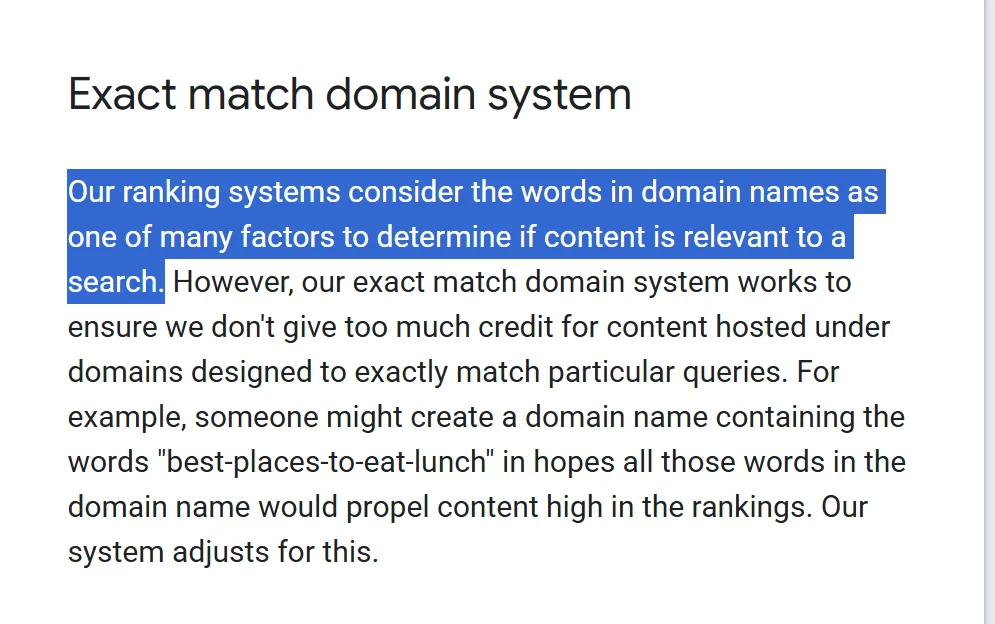
Google’s ranking systems guide says words in domain names are one of many relevance factors.
It also describes an exact-match domain system designed to prevent sites from receiving too much credit simply because their domains match a query.
This distinction is important when you compare a natural brand such as kilimanjarotrails.co.tz with a forced name such as best-cheap-kilimanjaro-tours-tanzania.example.
The second address repeats more keywords, but it is longer, harder to say, easier to mistype, and less flexible if the company expands into safaris or Zanzibar trips.
Use a service or location word when it makes the name clearer. Do not stack phrases merely to impress a search engine. Google can understand the topic from the page title, headings, body copy, internal links, structured data, and the wider site. Those signals give you far more room to satisfy a searcher’s actual question.
A Tanzanian domain can strengthen country targeting
The extension after the name can help define the intended market.
Google describes country-code top-level domains as a strong signal to users and search engines that a site targets a particular country.
That makes a .tz-based address a sensible option for many businesses, organisations, and projects focused on Tanzania.
The choice still depends on your operating plan:
Choose
.co.tzor another appropriate.tznamespace when Tanzania is the core market and the local identity supports the brand.Consider a suitable
.comor another generic extension when the same site must serve several countries without one market appearing primary.Use separate regional URLs and
hreflangcorrectly if you maintain genuinely distinct country or language versions.
A country-coded name does not make weak pages rank though.
Google also looks at other location signals, including local addresses, phone numbers, language, currency, links from local sites, and Business Profile information where available.
A Tanzanian domain works best when the website, offer, contact details, and reputation all support the same market.
Our guide to .com versus .co.tz goes deeper into the audience and brand trade-offs.
Choose the extension for the people you want to serve, not because someone promises that one ending always ranks above another.
Brandability supports SEO indirectly
A short, distinctive domain can support organic growth without acting as a direct ranking switch.
People need to recognise the name in search results, remember it after a conversation, type it on a phone, and share it without correcting the spelling.
A clear name can make those tasks easier. Consistent use across the website, email, social profiles, signage, and citations also reduces confusion about which business a result represents.
These are potential user and marketing benefits. Do not turn them into guaranteed claims about clicks, links, conversions, or rankings.
The result still depends on the offer, the search snippet, brand awareness, page quality, and competition.
Run a simple test before registering:
Say the domain aloud once and ask someone to type it.
Check whether the spelling could be confused with another business.
Remove unnecessary hyphens, numbers, and repeated words.
Ask whether the name still fits if the business adds a product or location.
Search the name for existing brands, negative associations, and trademark risk.
If the name needs a long explanation, more keywords will not repair it.
See our full guide to choosing a good domain name before committing your website and email addresses to it.
An old domain does not come with guaranteed SEO value
Age is easy to sell because it sounds measurable. A registration date, however, does not tell you whether the former site earned trustworthy links, served useful content, changed owners repeatedly, carried malware, or disappeared for years.
Buying an expired domain only for its supposed “authority” is especially risky.
Google’s spam policies define expired-domain abuse as buying and repurposing an expired name primarily to manipulate rankings with content that provides little or no user value.
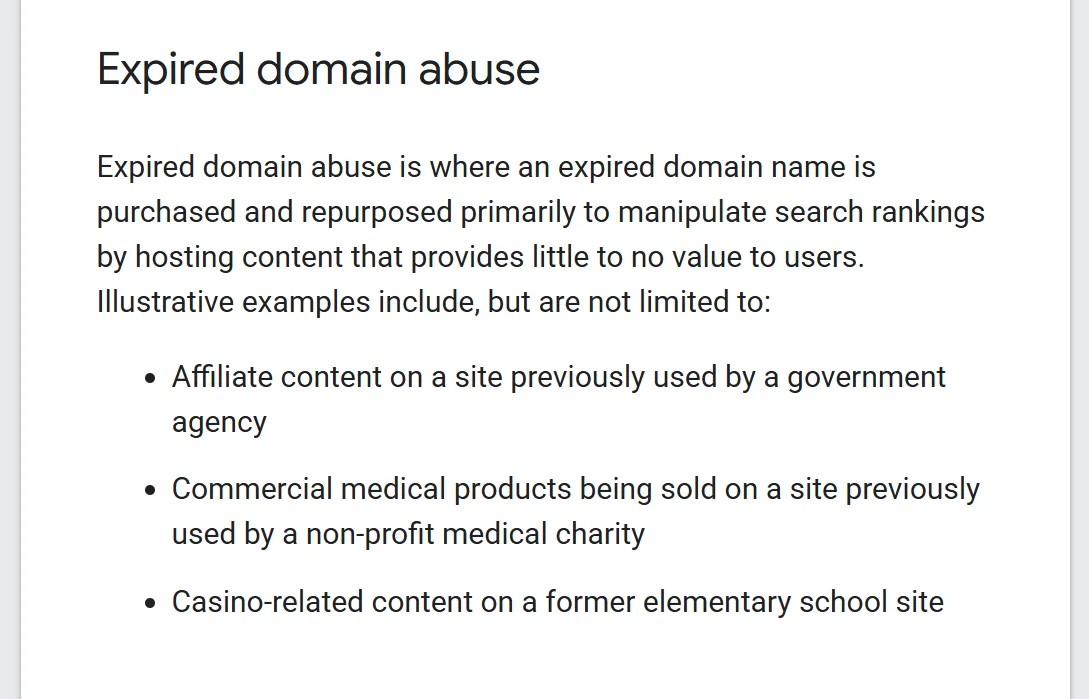
The policy targets abusive use; it does not say that every legitimate purchase of a previously used name is wrong.
Before buying an old or aftermarket domain:
review archived versions of the website;
inspect major backlinks and the pages they originally referenced;
search the name with words such as “scam,” “spam,” or “review”;
check for previous industries that conflict with your intended use;
verify ownership, transfer terms, renewal cost, and trademark exposure; and
value the name for its fit with your business, not for an unproven promise of inherited rankings.
Links may disappear, be ignored, or no longer make sense after a complete topic change. Build your forecast on the website you can create, not on authority that a seller cannot demonstrate.
Changing the domain can affect SEO because every URL changes
Replacing oldbrand.co.tz with newbrand.co.tz is not a cosmetic edit.
The home page and every internal page receive a new URL. Search engines must crawl the redirects, discover the destinations, process new canonical signals, and update their indexes.
Google notes that search visibility can fluctuate temporarily during a site move with URL changes.
A careful migration reduces avoidable loss, but nobody should promise a move with zero ranking movement.
Use this minimum migration plan:
Inventory the old URLs. Export indexable pages, images, downloads, canonicals, sitemaps, and important inbound links before changing anything.
Map each useful old URL to its closest new equivalent. Do not send every page to the new home page. Irrelevant mass redirects can confuse users and may be treated as soft 404s.
Use server-side permanent redirects. Google recommends
301or308redirects when the move will not be reversed. Point each old URL directly to the final destination and avoid chains.Update the new site. Replace internal links, canonicals, navigation, structured data, image references, and sitemap entries with the new URLs.
Verify both domains in Search Console. Submit the Change of Address for the old domain and account for its
www, non-www, and relevant subdomain variants.Submit the new sitemap and test representative redirects. Check high-traffic pages, deep pages, files, and common error cases.
Keep redirects for at least a year. Google’s current guidance says to keep them as long as possible, generally for at least one year, so signals and external links can be reassigned.
Monitor the move. Watch indexing, search queries, crawl errors, server logs, analytics, and conversions on both properties.
Do not combine a domain move with a major redesign, platform replacement, URL restructuring, and content rewrite unless the business has a compelling reason.
Fewer simultaneous changes make faults easier to find.
A registrar transfer is different. Moving the same domain between registrars does not rename the site or change its URLs.
The SEO migration risk arises when the public URLs, content delivery, DNS, or availability actually change.
Keep one primary domain and redirect alternatives
Businesses often buy common misspellings, matching extensions, or an old brand name for protection.
That can be useful, but each address should not host a separate copy of the same website.
Choose one primary domain. Use permanent redirects from the alternatives to the corresponding preferred URLs, and use consistent canonical tags, sitemap entries, internal links, and marketing links.
Google’s redirect guidance recommends selecting a preferred URL when people can reach the same page through several addresses.
Separate country websites are different when they provide genuinely local offers, language, currency, support details, and content.
Examples:
truehost.com
truehost.co.ke
truehost.ug
truehost.co.tz, etc
In that case, map the regional structure deliberately instead of cloning every page and hoping the extensions solve targeting by themselves.
Choose the domain you can build on for years
The strongest SEO-friendly domain is not necessarily the one with the most search terms.
It is the one that supports a credible business and avoids a preventable migration later.
Prioritise these qualities:
clear connection to the brand or purpose;
easy spelling and pronunciation;
a length that works on mobile screens and printed material;
an extension suited to the core market;
room for new products, locations, or services;
clean historical and legal checks;
affordable registration and renewal; and
direct control through an account the business owns.
Then invest in what creates durable search performance: answer real questions, publish original and useful material, make pages easy to crawl, earn relevant mentions, improve speed, and maintain the site.
A good domain makes that work easier to recognise and remember. It does not perform the work for you.
Ready to compare names?
Search for a domain with us, shortlist the options that fit your market, and choose the address you will be confident using long after the launch campaign ends.