 Web HostingMost affordable shared hosting from TZS 9,100 per year
 Dedicated ServersExperience unmatched power and control with a physical server in Tanzania.
 WordPress HostingHigh-Speed, Tanzania-Optimized WordPress Hosting
 Windows HostingOptimized for Windows-based applications and websites
 cPanel HostingUser-friendly hosting powered by cPanel
 Email HostingProfessional Tanzanian email hosting for your .co.tz domain (Secure, reliable, and Swahili-supported)
 Reseller HostingLaunch your own hosting business with minimal technical requirements
 Affiliate ProgramEarn referral commissions by promoting our services
 DomainsFind and register available domain names in seconds
 Domain TransferMove your domain to us with zero downtime and full control
 .co.tzSecure the trusted .co.tz domain made for Tanzanian businesses.
 .tz DomainClaim the official .tz domain for national trust and recognition.
 .com DomainSecure the trusted .com domain for Tanzanian businesses.
 Supported Tlds (glTLDs and ccTLDs)Browse and register domain extensions from around the world
 Whois Lookup | Find Out Who Owns a DomainLook up domain ownership, expiry dates, and registrar information
 VPS
VPS VPS Hosting TanzaniaDedicated resources. Tanzanian performance. Full server control.
 Managed VPS TanzaniaNot a tech expert? Choose a managed Tanzania VPS.
 Website BuilderEasily build beautiful websites with drag-and-drop simplicity.
 Online ShopLaunch a professional e-commerce store without writing code.
 BlogFind latest business, marketing, and tutorials
An exact-match domain, or EMD, is a domain whose main name matches a search phrase a website wants to target. For the query “Tanzania tours,” tanzaniatours.co.tz is an exact match.
That match can give Google a small relevance clue, but it does not guarantee a higher position.
Google uses many signals and operates an exact-match domain system that prevents keyword-matching names from receiving too much credit. Choose an EMD only when it also works as a clear, memorable, long-term business name.
What counts as an exact-match domain?
SEO practitioners usually compare the searchable words with the registrable part of the domain. They ignore spaces and often treat a hyphen as a separator. The extension helps identify the full address, but it does not form part of the keyword match.
Target query | Domain | Classification | Why |
|---|---|---|---|
Tanzania tours |
| Exact match | The main domain reproduces the complete query |
Tanzania tours |
| Exact match | The hyphen only separates the same words |
Tanzania tours |
| Partial match | The name adds “experts” |
Tanzania tours |
| Brand domain | The name identifies a brand instead of the generic query |
Tanzania tours |
| Exact-match page URL, not an EMD | The keyword appears in the path, not the domain name |
An EMD also differs from a domain that exactly matches a registered business name.
If your company trades as Twiga Trails and uses twigatrails.co.tz, the web address matches the brand. SEO specialists would not normally call it an EMD unless “Twiga Trails” is also the non-brand search phrase under discussion.
The distinction is important because “exact” refers to the keyword target, not merely to consistency between a company and its website.
Do exact-match domains improve Google rankings?
Not by themselves.
Google’s ranking systems guide gives the most precise current answer. Google considers words in domain names as one of many factors when it decides whether content relates to a search.
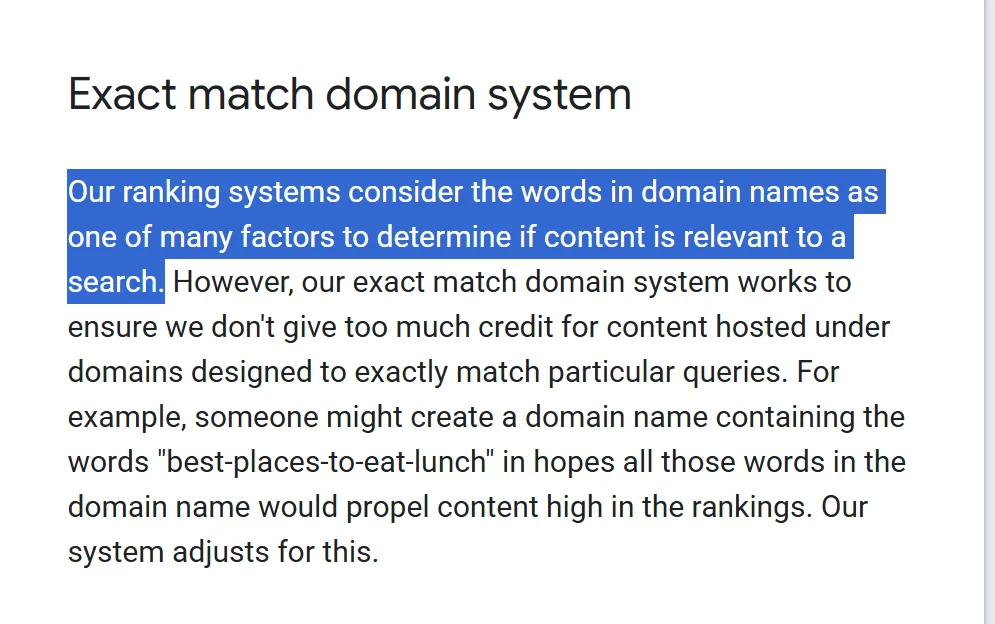
Its exact-match domain system also stops websites from receiving excessive credit merely because the domain mirrors a query.
This means two common claims are both too absolute:
“Keywords in a domain have no effect at all” ignores Google’s statement that the words can contribute to relevance.
“Buy the exact keyword and you will rank” ignores the system designed to limit that advantage and every other quality and relevance signal involved.
An EMD can rank first, tenth, or nowhere. The outcome depends on the website behind it: whether the pages satisfy the search intent, offer something useful, earn a sound reputation, work technically, and compete well against the alternatives.
A matching name cannot make thin pages comprehensive or turn an uncompetitive offer into the best result.
If you want to compare an exact-match idea with shorter branded options, use our domain search.
Check the full name with several suitable extensions before paying a premium for one keyword-heavy version.
An exact match can still provide commercial clarity
Ranking power is not the only reason to choose a domain. A concise descriptive name can tell a person what the website covers before they visit it.
Consider a marketplace called tanzaniacampsites.co.tz. The words define the category clearly. That may help when someone sees the address on a poster, hears it on radio, or receives it in a message.
A genuinely strong EMD can function as both a description and a brand.
These benefits remain conditional. A name does not automatically earn more clicks, trust, links, or sales. The search snippet, design, reputation, price, customer experience, and competing options all affect what a person does next.
An EMD has the best commercial case when it is:
short enough to say and type comfortably;
based on a phrase people naturally use;
closely aligned with the site’s permanent purpose;
distinctive enough to remember;
available at a sensible total cost; and
free from obvious ownership, history, or trademark problems.
The name should survive a radio test. Say the full address once without spelling it. If the listener cannot reproduce it, the “exactness” has not removed much friction.
Keyword-heavy domains can create expensive constraints
An exact match solves one naming problem while potentially creating several others.
The phrase may be too long
bestaffordableaccountingservicesdar.co.tz may target several useful words, but it performs poorly as an address. People must remember the order, avoid typing errors, and fit it into email addresses and printed material.
Removing generic modifiers usually produces a stronger candidate. The goal is not to store a page title inside the domain.
The name may restrict growth
A company that starts with office cleaning in Dar es Salaam might consider officecleaningdar.co.tz. The name fits the launch offer. It becomes awkward when the company adds home cleaning, expands to Arusha, or sells supplies.
Changing domains later means changing public URLs, email addresses, campaign materials, and customer habits.
It also creates an SEO migration that needs redirects and careful monitoring. A broader brand can avoid that cost.
Generic words can weaken differentiation
A category phrase tells people what you sell, but it may not tell them why they should remember you. Several competitors can use similar combinations of “Tanzania,” “safari,” “tours,” “travel,” and “adventures.”
A distinctive brand gives you language that competitors cannot describe themselves with as naturally.
You can still explain the category in page titles, headings, copy, and service pages.
The domain does not need to carry the entire SEO strategy.
Multiple EMDs can become doorway abuse
Do not register a collection such as plumberdar.example, plumberarusha.example, and plumberdodoma.example, publish near-identical sites, and funnel every visitor to one business page.
Google’s current spam policies list multiple domains or pages that target regions or cities and funnel users to one destination as an example of doorway abuse.
Build one coherent website with useful local pages when the business genuinely serves those places. Do not manufacture a network of keyword doors.
The desirable EMD may cost too much
A seller may price a clean category domain far above a normal registration, as these are often termed as ‘premium domains’.
The fact that a name exactly matches a query does not prove that the extra cost will return through rankings or sales.
Compare the full acquisition and renewal cost with workable brand or partial-match alternatives. Keep enough budget for the product, website, content, promotion, and service that make the address valuable.
Compare the EMD with a brand in the real business context
Imagine a new Tanzanian company that currently provides office cleaning in Dar es Salaam.
The EMD option is officecleaningdar.co.tz. It describes the initial service and location precisely. It could make sense if the company plans to stay specialised, the name remains affordable, and customers can repeat it accurately.
The brand option is safiworks.co.tz. It does not match the service query, but it is shorter and leaves room for home cleaning, facilities management, supplies, or expansion into other cities.
The website can target “office cleaning in Dar es Salaam” on a dedicated service page without putting the complete phrase in the domain.
Neither address wins the ranking decision automatically. The correct choice follows the business model:
Choose the EMD when the phrase makes a good name even after you remove the supposed SEO bonus.
Choose the brand when the exact phrase makes the address longer, narrower, harder to defend, or more expensive than its commercial value.
That “remove the SEO bonus” test cuts through most sales pitches. If you would reject the name without promised rankings, do not buy it for rankings.
Use a seven-question EMD test before registering
Score the name against practical evidence, not enthusiasm.
Does it match the real offer? A high-volume phrase has little value if it attracts people looking for a different product, price point, or location.
Can someone reproduce it after hearing it once? Test the complete domain, including the extension.
Will it still fit in three years? List the products and markets you may add. Reject a name that makes likely growth sound unrelated.
Is a shorter brand or partial match stronger? Compare at least three candidates side by side. Our guide to choosing a good domain name provides broader naming checks.
Are the rights and history clean? Search business names and trademarks, review archived pages if someone used the domain before, inspect suspicious backlinks, and investigate negative mentions. Registration availability does not grant trademark rights.
Can the business afford the full cost? Include purchase, renewal, transfer, and any rebranding or migration work. Do not evaluate only the first payment.
Can you build the best resource behind it? Define the pages, expertise, products, evidence, and support that will satisfy visitors. If the plan ends at buying the name, the SEO plan has not begun.
An EMD that passes all seven questions can be a sound domain. One that only passes “contains our keyword” needs more work.
If you already own an exact-match domain, build a real brand on it
You do not need to abandon a useful EMD because Google limits excess keyword credit.
Treat it as the address of a business, not as an optimisation trick.
Use a recognisable brand name and visual identity instead of repeating the generic phrase everywhere.
Create pages around distinct customer needs rather than producing minor keyword variations.
Write naturally; the domain already states the category.
Keep one primary site and redirect defensive domains to it.
Earn mentions for useful work, expertise, tools, data, service, or products—not merely for owning the phrase.
Monitor Search Console to see which pages and queries actually attract impressions and clicks.
The exact-match name may help people understand the subject, but the website must give them a reason to choose and recommend it.
Buy the name for the business, not the ranking promise
Exact-match domains still affect relevance in a limited way. They do not provide a dependable shortcut to high rankings, and Google specifically prevents them from receiving too much credit for the match alone.
Choose an EMD when the phrase is concise, natural, affordable, legally safe, and broad enough for the business you intend to run. Choose a brandable or partial-match domain when it creates a clearer identity and more room to grow.
Ready to test both routes? Search for a domain with us, compare the exact keyword with stronger alternatives, and register the name that still makes sense without an SEO promise attached.