 Web HostingMost affordable shared hosting from TZS 9,100 per year
 Dedicated ServersExperience unmatched power and control with a physical server in Tanzania.
 WordPress HostingHigh-Speed, Tanzania-Optimized WordPress Hosting
 Windows HostingOptimized for Windows-based applications and websites
 cPanel HostingUser-friendly hosting powered by cPanel
 Email HostingProfessional Tanzanian email hosting for your .co.tz domain (Secure, reliable, and Swahili-supported)
 Reseller HostingLaunch your own hosting business with minimal technical requirements
 Affiliate ProgramEarn referral commissions by promoting our services
 DomainsFind and register available domain names in seconds
 Domain TransferMove your domain to us with zero downtime and full control
 .co.tzSecure the trusted .co.tz domain made for Tanzanian businesses.
 .tz DomainClaim the official .tz domain for national trust and recognition.
 .com DomainSecure the trusted .com domain for Tanzanian businesses.
 Supported Tlds (glTLDs and ccTLDs)Browse and register domain extensions from around the world
 Whois Lookup | Find Out Who Owns a DomainLook up domain ownership, expiry dates, and registrar information
 VPS
VPS VPS Hosting TanzaniaDedicated resources. Tanzanian performance. Full server control.
 Managed VPS TanzaniaNot a tech expert? Choose a managed Tanzania VPS.
 Website BuilderEasily build beautiful websites with drag-and-drop simplicity.
 Online ShopLaunch a professional e-commerce store without writing code.
 BlogFind latest business, marketing, and tutorials
A domain registry operates the authoritative database for an extension such as .tz or .com.
A domain registrar gives you the customer-facing service through which you search, register, renew, transfer, and manage a domain.
You do not normally choose a registry and a registrar as competing products. Your chosen extension determines the registry. You choose the registrar that handles your account and sends authorised requests to that registry.
In Tanzania, this distinction tells you who sets .tz rules, who takes your order, who records the domain, and whom to contact when something goes wrong.
Registry vs Registrar
Three roles take part in an ordinary registration: the registry, the registrar, and you as the registrant.
Role | Main job | Example | Do you choose it? |
|---|---|---|---|
Domain registry | Maintains the authoritative registration database and technical infrastructure for an extension | TCRA manages | The extension determines it |
Domain registrar | Provides the account, purchase, renewal, transfer, and management service | The provider through which you order the domain. Example is Truehost | Yes |
Domain registrant | Holds the right to use the registered name under the applicable terms | You, your company, or your organisation | You must ensure the record names the correct holder |
A simple retail analogy helps, but only up to a point. The registrar acts like the shop where you place and manage the order. The registry acts like the authoritative stock and ownership record for the extension.
The registry does more than a wholesaler, however: it also operates technical systems that help the extension function in the Domain Name System.
Follow one .co.tz registration from search to the registry
Suppose you want yourbrand.co.tz for a business in Dar es Salaam.
You enter the name into a registrar’s search tool.
The registrar checks the
.tzregistry to see whether the name remains available.You provide the registrant and contact details and pay through the registrar.
The registrar sends the registration request to the registry.
The registry creates the authoritative record and associates it with that registrar.
The registry publishes the required delegation data so DNS resolvers can find the domain’s authoritative nameservers.
The registry never replaces the customer account in this flow. The registrar never replaces the registry’s master record.
Each side performs a different part of the same transaction.
If you are ready to register a domain name, use our instant domain search and registration service.
We provide the customer-facing registration path, while the registry responsible for your chosen extension maintains the authoritative record behind it.
A registry runs the authoritative record for an extension
ICANN defines a registry operator as the organisation that maintains the master database of names inside a particular top-level domain.
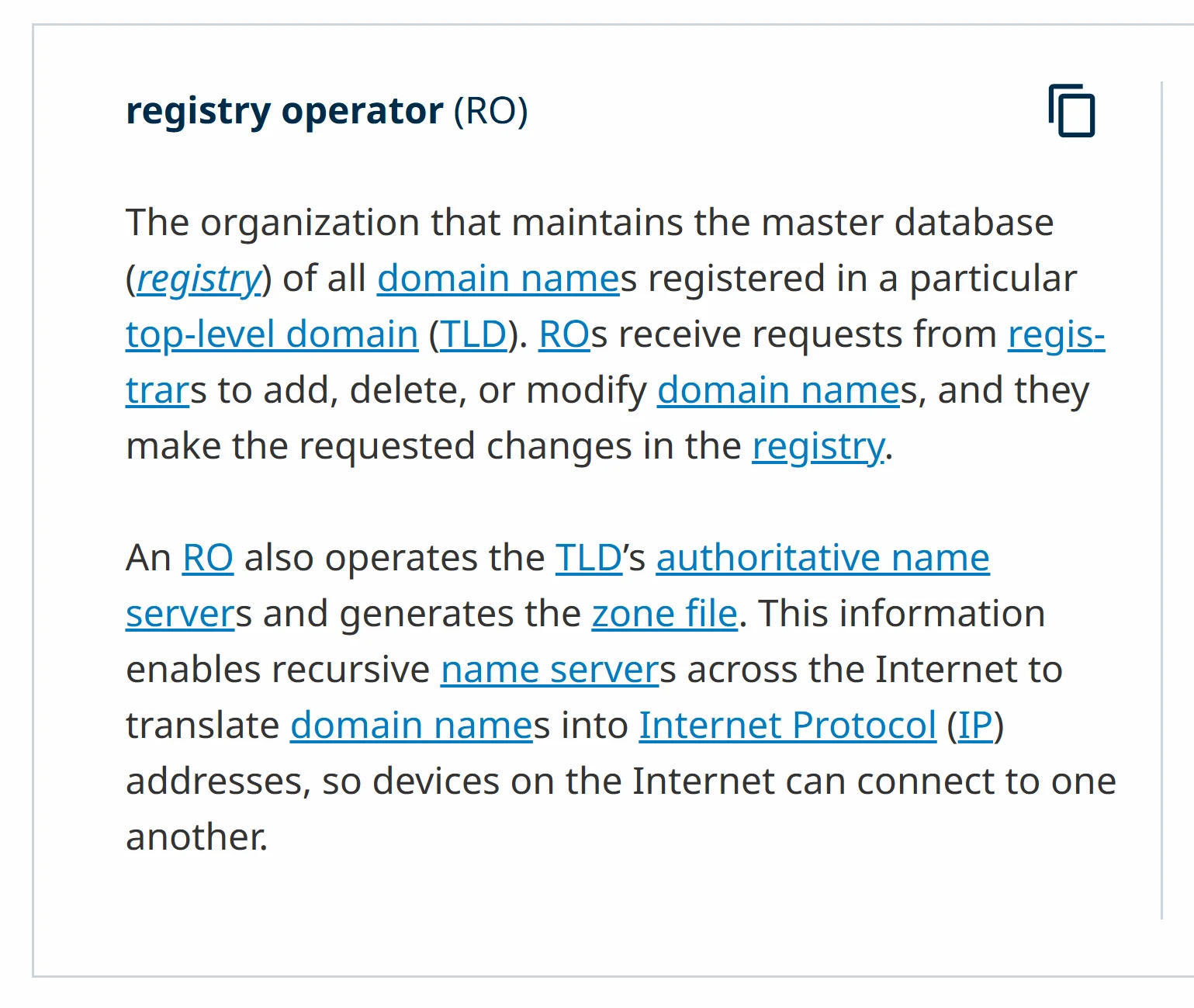
The operator accepts authorised requests from registrars to add, delete, or modify records.
It also operates the extension’s authoritative nameservers and generates zone data.
One registry can support many registrars. That structure lets several customer-facing providers sell and manage names under the same extension without creating conflicting copies of the registry.
The registry’s responsibilities normally include:
deciding whether a requested name already exists in its database;
recording the domain, sponsoring registrar, status, contacts, and nameserver delegation required by its model;
applying the extension’s eligibility, lifecycle, transfer, and technical rules;
accepting valid registration, renewal, transfer, update, restore, and deletion commands; and
operating the technical systems that publish the extension into DNS.
The extension identifies the relevant registry. IANA lists TCRA as the country-code manager for .tz.
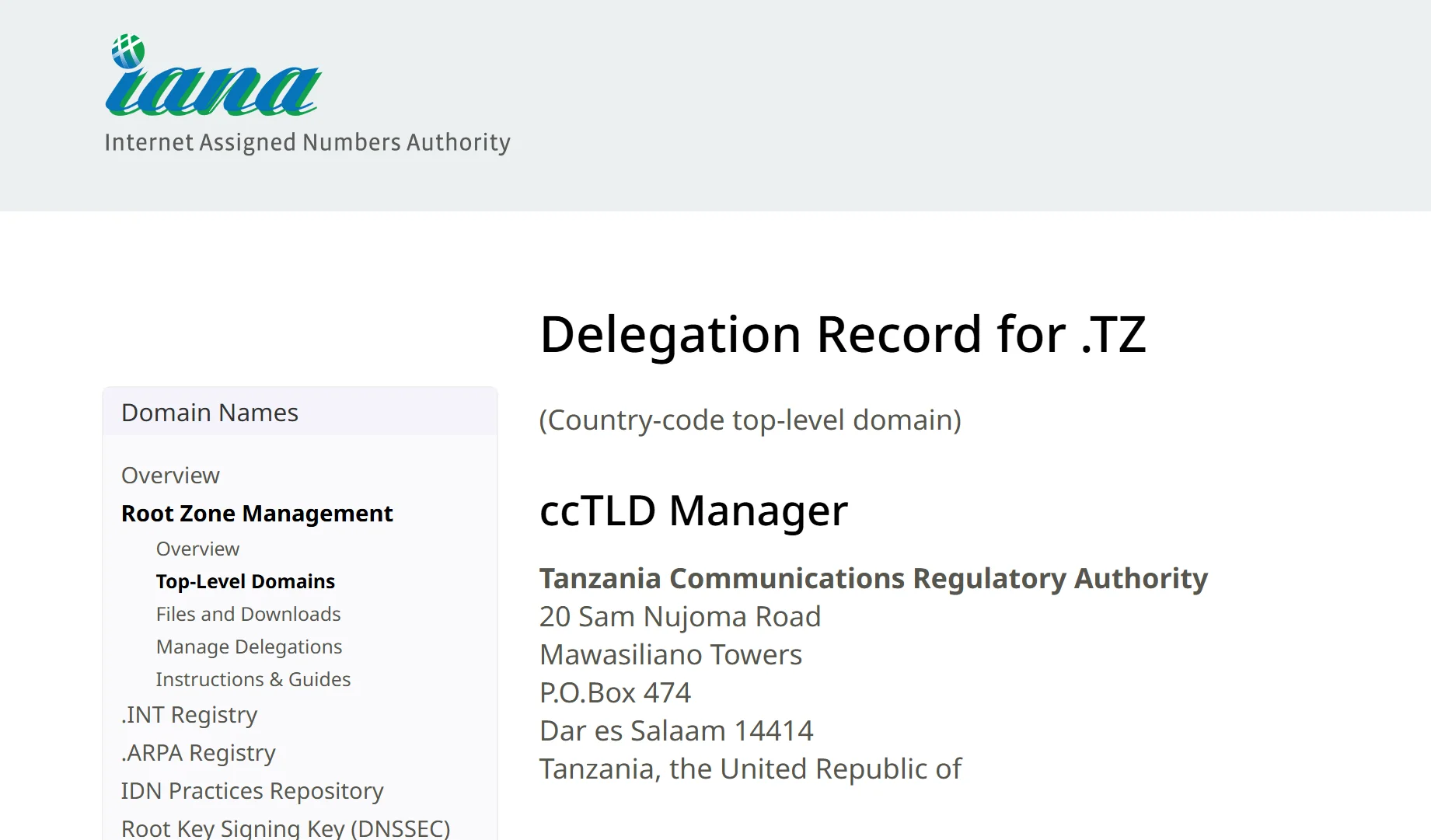
IANA lists Verisign as the sponsoring organisation for .com. Registering a .com through a Tanzanian provider does not move the .com registry to Tanzania; Verisign still operates the extension’s registry.
A registrar handles your domain account
The registrar sits between you and the registry. It turns registry operations into a service that a person or business can buy and manage.
A registrar may provide:
domain availability search and checkout;
account access and payment records;
registration and renewal requests;
registrant and administrative contact management;
nameserver updates;
transfer locks and transfer-code workflows where the extension supports them;
expiry notices and restoration requests; and
support when a registry command fails or the domain status blocks an action.
The exact controls depend on the extension, registry policy, and registrar. A .co.tz dashboard does not have to behave exactly like a .com dashboard.
TCRA’s current .tz FAQ defines a registrar as a legal entity that the Authority accredits to add, modify, change, or delete names in the .tz namespace.
Tanzania’s registration rules direct an applicant to an accredited registrar rather than asking the applicant to write directly into the registry database.
A reseller can add another customer-facing layer. ICANN’s registration-process guide explains that a reseller works under a registrar’s agreement and does not hold ICANN accreditation in its own right.
If a brand does not appear as the registrar in a generic domain’s registration record, it may use an upstream registrar for the registry connection.
You are the registrant, not the registrar
The person or organisation that holds the registration rights acts as the registrant.
You sign or accept a registration agreement with the registrar, while the registrar maintains the operational relationship with the registry.
This role affects control.
TCRA recognises the company or individual listed in the registry database as the .tz domain holder.
If a web developer, employee, or agency registers the name for your business, make sure the record identifies the business or intended owner as registrant.
Keep your own evidence as well:
the registration confirmation and invoices;
the registrar name and account address;
registrant and administrative contact details;
renewal and expiry records; and
the names of people authorised to change or transfer the domain.
Registration gives the registrant a renewable right to use the name under the registry and registrar terms. It does not create permanent ownership regardless of expiry, policy, or disputes.
Registry rules and registrar service both affect the price
The registry controls the extension-level requirements and charges that apply to registrars under its model.
The registrar sets the retail offer presented to you, which may also reflect support, payment processing, taxes, privacy options, DNS service, and other account features.
That division explains why two registrars can quote different totals for the same extension even though both send requests to one registry.
It also explains why one provider may offer better account controls or support without changing the underlying registry.
Compare the complete buying terms rather than the first registration figure alone:
initial registration and normal renewal;
transfer and restoration charges;
included or optional privacy protection;
payment methods and billing currency;
account-security controls;
DNS-management tools; and
support and escalation routes.
The registry’s policies can still limit what every registrar may do.
A registrar cannot ignore a restricted extension’s eligibility rule or force the registry to restore a deleted name after the allowed recovery period ends.
Registrar, DNS provider, and web host can be different companies
The registrar manages the registration relationship.
A DNS provider hosts the zone containing records such as
A,AAAA,MX, andTXT.A web host stores and serves the website files or application.
One provider may perform all three jobs, but the roles remain separate.
You can register a domain with one company, use another company’s nameservers, and host the website somewhere else.
The registry usually records which authoritative nameservers serve the domain. The DNS provider answers queries through those nameservers. The web host responds after the DNS records direct traffic to its server.
This distinction prevents wasted support requests. A registrar can help with a nameserver delegation or registration status, but it may not control a broken WordPress plugin. A web host can fix server files, but it may not have authority to unlock a transfer at another registrar.
A transfer changes the registrar, not the registry
When you transfer your domain say yourbrand.co.tz from one registrar to another, the domain remains inside the .tz registry.
The registry changes the registrar associated with the record after the transfer meets its rules.
The registrant can remain the same. The nameservers can also remain the same, so a registrar transfer does not inherently require a website migration.
Changing yourbrand.co.tz to yourbrand.com is not a transfer. Those are two separate domain registrations under two registries. You can register the .com, move the website or redirect traffic, but the new extension creates a different name.
If you plan to move an existing name, follow the extension-specific steps in our guide to transferring a domain in Tanzania.
Match the problem to the organisation that controls it
Problem | Best first contact | Reason |
|---|---|---|
You cannot sign in, pay, renew, or update account contacts | Registrar or reseller that billed you | It controls the customer account |
A registration, renewal, transfer, or restore command failed | Registrar | It can inspect the status and communicate with the registry |
You need the | Current | TCRA documents the Registry Key process for |
An | DNS provider | It hosts the active DNS zone |
Website files, database, or server software failed | Web host or developer | The registry and registrar do not host the website merely because they manage the name |
You need the official policy or registrar list for | TCRA and Karibu | TCRA manages the namespace and publishes the accredited-registrar route |
You need to identify a generic domain’s current registrar | Registration data normally identifies the sponsoring registrar |
Start with the registrar for most registration problems. The registrar holds your account context and can escalate a registry-side issue without asking you to diagnose the back-end command.
Verify the service layer before you register
For a .tz, .co.tz, or another name in the Tanzanian namespace, check the accredited registrar route published through Karibu.
Confirm that the provider supports the exact extension and ask which legal entity will appear as the registrar or reseller in your documents.
For a generic domain, use ICANN Lookup to identify the registrar after registration. IANA’s Root Zone Database identifies the organisation responsible for each top-level domain.
Before paying, confirm five things:
The registrant field will name you or the correct organisation.
You know the normal renewal terms, not only the introductory offer.
The account supports the security and transfer controls you need.
You can reach support through a verified channel.
You know who controls DNS and hosting after the registration succeeds.
Our domain registration walkthrough covers the customer steps from availability search through DNS setup.
Choose the registrar; understand the registry behind it
The registry keeps one authoritative record for an extension. The registrar gives you the account and service used to create and manage your entry in that record. You choose the registrar, while the extension fixes the registry.
That knowledge makes domain shopping more useful. Compare registrars on renewal terms, support, account security, transfer handling, and management tools. Check the registry when you need the official extension rules or lifecycle.
Ready to secure a name for your business? Search and register your domain with us, then keep your registrant details and renewal records under your control.